
Introduction
Choosing the right insulated panel often comes down to PUF panels vs PIR panels. They look almost identical on a wall, and the numbers on a spec sheet sit close together, but the two behave differently in ways that matter once a building is in service. Here’s a straightforward comparison to help you decide.
What Are PUF and PIR Panels?
PUF stands for polyurethane foam. A PUF panel is an insulated sandwich panel with two metal skins bonded to a rigid foam core. PIR stands for polyisocyanurate, which is essentially a chemically modified version of the same foam. During manufacturing, PIR uses a higher proportion of isocyanate, and that single change gives the core a tougher, more heat-stable structure.
So the honest way to describe them: PIR is a close relative of PUF, not a completely different material. That family resemblance explains why their insulation values are so similar, and why their fire behavior is not.
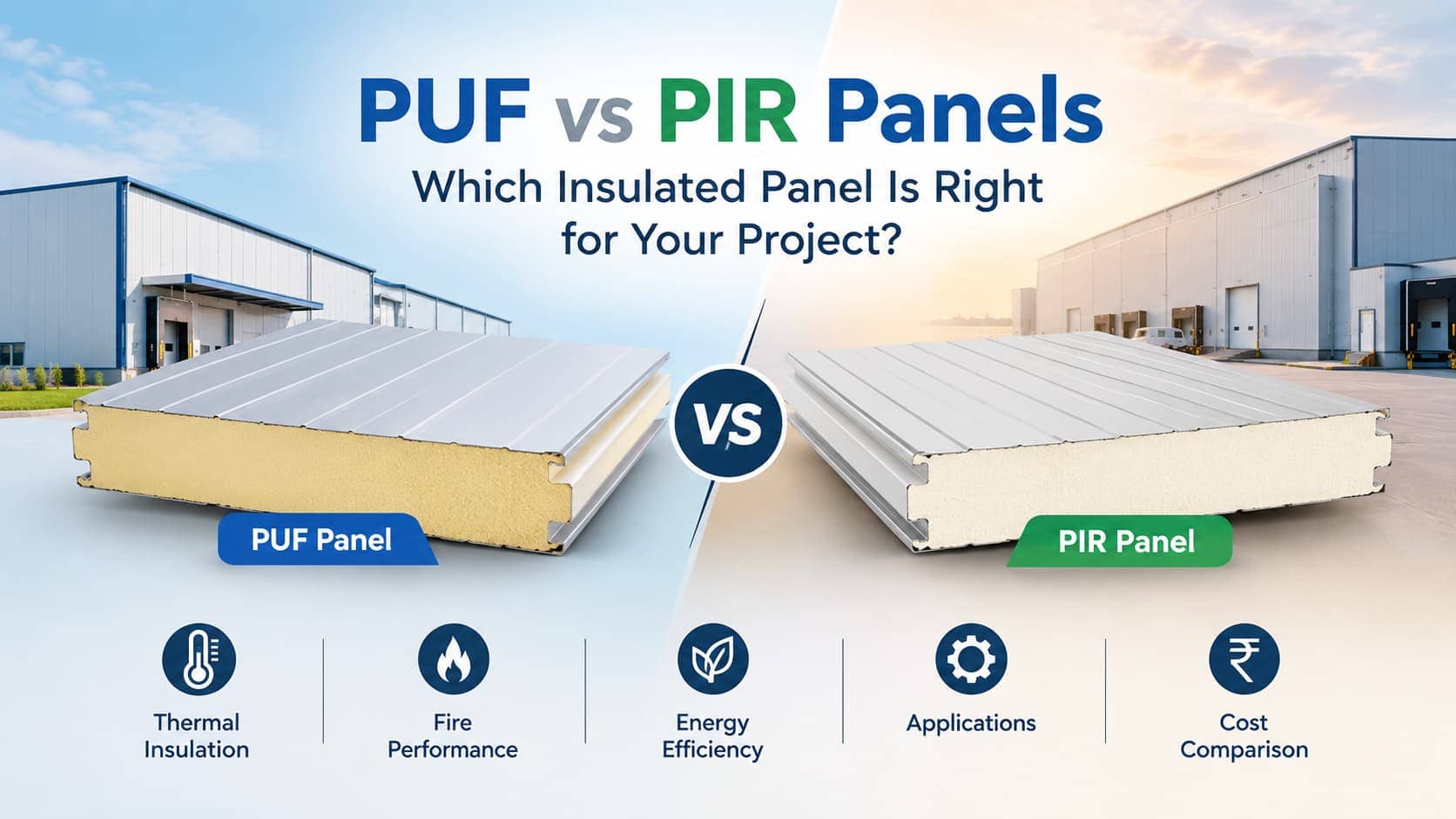
The Key Differences
The core distinction is in the chemistry. PUF melts and drips when it meets sustained high heat. PIR tends to char instead, forming a protective layer on its surface that slows the spread of heat into the panel. That charring behavior is the reason PIR is generally the preferred choice wherever fire safety is a serious concern.
Thermal Insulation Performance
Both materials insulate very well. Thermal conductivity for either typically lands around 0.020 to 0.023 W/mK, which is why a 50 mm PUF panel and a 50 mm PIR panel of the same thickness perform almost the same in a normal room. Where PIR pulls ahead is at higher temperatures. As surrounding heat rises, PUF loses some of its insulating ability faster than PIR does, so for hot environments or roofs under strong sun, PIR holds its performance a little better.
Fire Performance and Safety
This is where the two genuinely separate. PIR reaches higher fire classifications more easily and produces less smoke and dripping in a fire. PUF panels can be treated with fire-retardant additives and are perfectly acceptable for many applications, but if a project has strict fire compliance requirements, PIR is usually the safer specification. Always check the actual tested rating on the product rather than assuming, since results vary by manufacturer and core density.
Energy Efficiency and Temperature Control
For cold storage, controlled-temperature warehouses, and anywhere running costs depend on keeping heat in or out, both panels reduce energy loss significantly. The right thickness matters more than the choice between PUF and PIR for day-to-day efficiency. A thicker PUF panel can outperform a thinner PIR one, so size the panel to the temperature difference you need to maintain.
Applications
PUF panels are widely used in cold rooms, food processing units, general warehousing, and factory walls and roofs. PIR panels tend to be specified in the same settings but especially where fire regulations are demanding, such as certain commercial buildings, pharmaceutical facilities, and high-value storage.
Cost and Long-Term Value
PUF is usually the more economical option upfront. PIR costs a bit more because of its formulation and fire performance. The better way to weigh this is over the life of the building. If the project carries fire-safety risk, the added cost of PIR is easy to justify. If it does not, PUF often gives excellent value.
How to Choose
Start with the fire requirement, then the operating temperature, then the budget, and finally the panel thickness. And whichever you pick, the manufacturing quality matters as much as the material. Consistent core density, proper adhesion between skins and foam, and accurate thickness are what determine whether a panel actually performs the way its data sheet promises.