
Introduction
Most sandwich panel conversations start and end with PUF. It’s cheaper, it insulates well, and for the majority of industrial buildings it does the job. But there’s a category of projects where PUF simply isn’t allowed through the door: buildings where fire regulations demand a non-combustible core. That’s where mineral wool panels come in.
A mineral wool sandwich panel trades a little thermal efficiency for something PUF cannot offer at any price, which is a core that will not burn. For paint shops, battery storage, high-rise cladding, and any facility where the fire officer has the final word, that trade is not optional.
This guide explains what these panels are, how they’re made, where they’re used, and how they stack up against PUF, so you can decide which one your project actually needs.
What is a Mineral Wool Panel?
A mineral wool panel is a sandwich panel with a core of stone wool bonded between two steel facings. The stone wool is made by melting volcanic rock, mostly basalt, at around 1,500°C and spinning it into fine fibres, a bit like making candy floss from molten stone. Those fibres are compressed into rigid slabs that trap air, which is what gives the material its insulating and sound-absorbing properties.
Because the core is literally made of rock, it doesn’t burn. Mineral wool is classified as non-combustible (Euro class A1, the highest rating), and it holds its shape at temperatures above 1,000°C. Fire resistant sandwich panels built with rockwool cores can achieve fire ratings of 30, 60, 90, 120,180 & 240 minutes depending on thickness and construction.
The facings are typically pre-painted galvanised steel in 0.45 mm to 0.6 mm thickness, with profiles and joints similar to other sandwich panels. From the outside, a mineral wool panel and a PUF panel look nearly identical. The difference is entirely in what happens when things go wrong.
 How mineral wool panels are manufactured
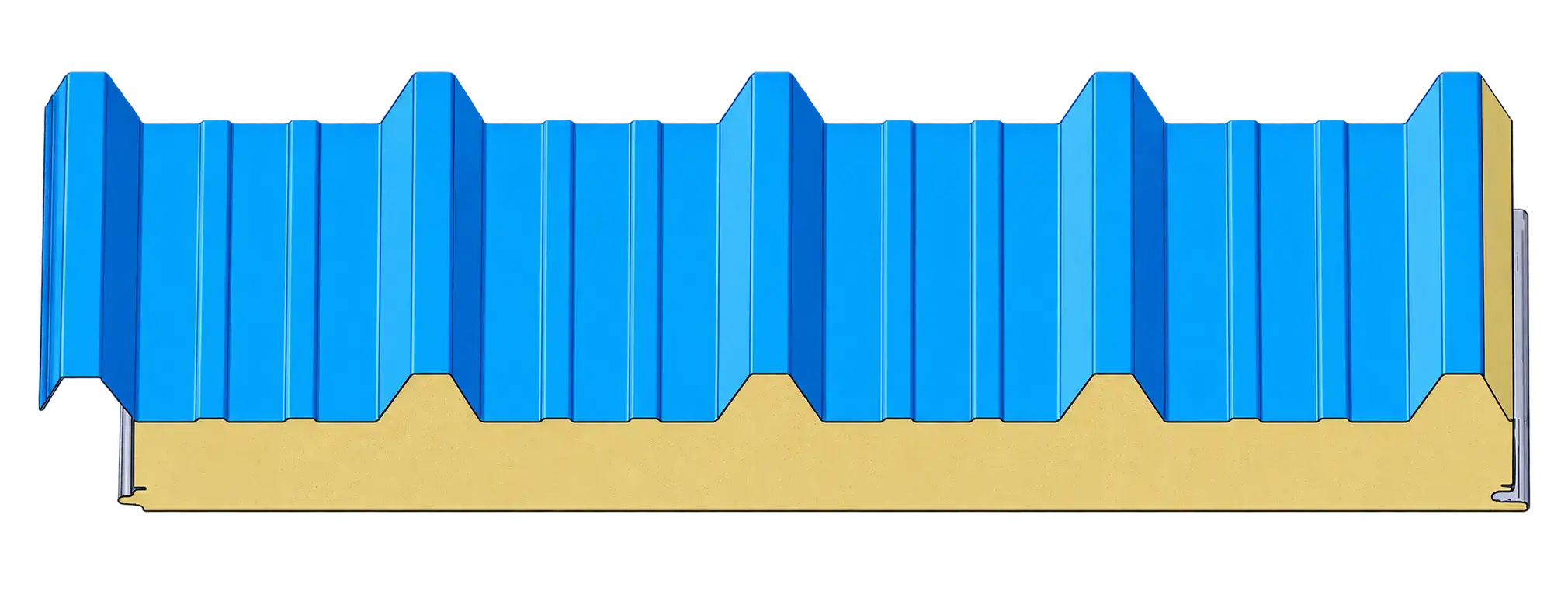 How mineral wool panels are manufactured
The process differs from PUF panel production in one fundamental way: the core arrives as a solid material rather than being foamed in place.
- Slab preparation: Mineral wool slabs are cut into strips (lamellas) and rotated so the fibres run perpendicular to the panel facings. This orientation matters a lot. Fibres standing on end give the panel far better compressive and pull-through strength than fibres lying flat.
- Facing preparation: Steel coils are decoiled, profiled, and cleaned, the same as any sandwich panel line.
- Adhesive application: A two-component polyurethane adhesive is applied to the inner faces of the steel. Since its doesn’t bond chemically to steel the way expanding foam does, adhesive quality and coverage decide the panel’s long-term integrity.
- Lamination and pressing: The lamellas are laid between the facings and the assembly passes through a press where the adhesive cures under controlled heat and pressure
- Cutting and finishing: Panels are cut to length, edges are finished with the joint profile, and the panels are stacked for dispatch.
On a continuous line, this happens in one uninterrupted flow, giving the same consistency benefits that continuous production brings to PUF panels: uniform pressing, flat surfaces, and flexible lengths.
Types of Mineral Wool panels
Fire rated wall panels. The workhorse of the range. Used for external walls, internal partitions, and fire compartment walls, in thicknesses from 50 mm to 150 mm. Ratings from 30 to 1280 minutes depending on spec.
Fire rated roof panels. A trapezoidal weather profile on top with a mineral wool core below. Common where insurers or codes require a non-combustible roof, such as chemical plants and warehouses storing flammable goods.
Acoustic panels. Stone wool panel absorbs sound far better than closed-cell foams, so perforated-facing versions are used for generator rooms, test cells, and machinery enclosures.
Partition and ceiling panels. Lighter-duty internal panels for compartmentation inside factories, commercial kitchens, and utility areas.
Densities typically run from 100 to 150 kg/m³ for the core, and higher densities are used where more structural strength or a higher fire rating is needed.
Key Features:
Non-combustible core: The defining feature. Stone wool panel doesn’t ignite, doesn’t spread flame, and doesn’t produce the toxic smoke that burning plastics do. In a fire, the panel acts as a barrier rather than fuel.
High temperature stability: Stone wool fibres withstand temperatures above 1,000°C without melting, which is why these panels hold together long enough to earn 60 and 120 minute ratings.
Sound absorption: The open fibre structure absorbs sound instead of reflecting it. A 100 mm panel can achieve sound reduction in the range of 30 to 32 dB, noticeably better than PUF of the same thickness.
Water and vapour behaviour: Quality stone wool is water repellent but vapour permeable, so it resists bulk water while letting incidental moisture dry out. Panels should still be detailed to keep the core dry, since saturated wool loses insulation value.
Dimensional stability: Mineral wool doesn’t expand, contract, or creep meaningfully with temperature changes, so panels stay flat and joints stay tight over the years.
No pests, no rot: There is nothing in stone fibre for insects, rodents, or fungus to eat.
Benefits:
The practical payoffs follow from those features. Buildings that use mineral wool insulated panels get easier fire NOC approvals and often lower insurance premiums, because insurers price the difference between a combustible and non-combustible envelope quite seriously. Occupants get quieter interiors, which matters more than people expect in facilities running compressors or generators around the clock.
There’s also a longevity argument. Because the core doesn’t degrade, off-gas, or lose thickness, the thermal and acoustic performance you measure in year one is roughly what you’ll measure in year twenty. And at the end of life, stone wool is recyclable back into new stone wool, which is starting to matter in green building certifications.
Applications:
These panels show up wherever fire risk, regulation, or noise drives the specification:
- Paint booths and spray shops, where solvent vapours make PUF a non-starter
- Battery manufacturing and energy storage facilities
- Chemical, petrochemical, and oil and gas installations
- Fire compartment walls inside warehouses and factories
- Commercial kitchens and food processing units with open flame
- High-rise and public buildings where codes mandate non-combustible cladding
- Generator rooms, DG enclosures, and acoustic barriers
- Data centres, where fire containment protects equipment worth far more than the building
- Airports, metro stations, and other public infrastructure
A useful rule of thumb: if the fire officer, the insurer, or the noise consultant is involved in your panel decision, you’re probably in stone wool territory.
Mineral Wool panel vs PUF panel
This is the comparison almost every buyer ends up making, so here it is side by side:
Parameter | Mineral Wool Panel | PUF Panel |
|---|---|---|
Core material | Stone wool (mineral fibre) | Rigid polyurethane foam |
Fire behaviour | Non-combustible, Euroclass A1 | Combustible, B/C class |
Fire rating | Up to 120 minutes | Limited; core melts and burns |
Thermal conductivity | ~0.038 to 0.042 W/mK | ~0.022 to 0.024 W/mK |
Insulation per mm | Lower; needs more thickness | Higher; thinner panels suffice |
Sound insulation (100 mm) | ~30 to 32 dB | ~24 to 26 dB |
Panel weight (100 mm) | ~18 to 22 kg/m² | ~11 to 13 kg/m² |
Water behaviour | Repellent but must stay dry | Closed cell, low absorption |
Cost | Higher | Lower |
Best suited for | Fire rated and acoustic applications | Cold storage, general insulation |
The short version: PUF wins on insulation, weight, and price. Mineral wool wins on fire and sound, and in fire rated applications it isn’t really a competition, because PUF is simply not permitted.
Plenty of projects use both. PUF for the cold rooms and general envelope, stone wool / mineral wool for the fire walls, plant rooms, and any elevation the fire code covers. There’s no rule that says a building has to pick one.
Factors to Consider Before Choosing Mineral Wool Panels
Fire rating required: Check what the local fire code, your insurer, and your consultant actually demand: 30, 60, 90, or 120 minutes. The rating drives thickness and density, and over-specifying wastes money while under-specifying fails approval.
Core density and fibre orientation: Ask for the core density (100 to 150 kg/m³ is the usual range) and confirm the lamella construction. Low-density cores with flat fibre orientation are cheaper and noticeably weaker.
Certification, not claims: A fire rated panel is only as good as its test report. Ask for test certificates from a recognised laboratory for the exact panel construction being supplied, including thickness, density, facing gauge, and joint type.
Thermal requirement: Because mineral wool conducts more heat than PUF, you may need 100 mm of stone wool where 60 mm of PUF would do. Factor that into wall thickness and cost comparisons.
Structural spans: These panels are heavier, so check the purlin spacing and load tables rather than assuming PUF span charts carry over.
Moisture detailing: Joints, flashings, and cut edges need proper sealing. A wet stone wool core insulates poorly until it dries, so installation quality matters as much as panel quality.
Supplier capability: Mineral wool panel manufacturing is less forgiving than PUF production. Adhesive application, pressing, and lamella handling all affect the finished panel, so factory process control is worth asking about before you order.
Why Choose BNAL Mineral Wool Sandwich Panels
BNAL Prefabs manufactures mineral wool / stone wool sandwich panels alongside our PUF and PIR range, which puts us in a useful position: we have no reason to push one core over another, because we make both. Our recommendation depends on your fire requirement, your budget, and your building, not on what happens to be in stock.
Our panels use lamella-oriented stone wool cores in the 100 to 150 kg/m³ density range, bonded to pre-painted galvanised steel facings on a controlled production line. Wall and roof profiles are available in standard thicknesses from 50 mm to 150 mm, with joint designs suited to fire rated construction. Test documentation is provided with supply, and our technical team helps with thickness selection, span checks, and installation detailing.
If your project mixes requirements, say cold storage plus a fire wall plus an acoustic DG room, we can supply the full panel package from one factory, which simplifies both procurement and site coordination.
Conclusion
Mineral wool sandwich panels exist for the projects where “it probably won’t catch fire” isn’t good enough. They cost more than PUF and need a little more thickness to insulate, but they bring something no foam panel can: a core made of stone that will not burn, backed by fire ratings that regulators and insurers accept.
If your building involves fire rated walls, acoustic enclosures, or an occupancy type where codes rule out combustible cores, This panel is the right tool. And if you’re not sure which side of that line your project falls on, talk to BNAL Prefabs. We manufacture both mineral wool and PUF panels, and we’d rather help you specify the right one than sell you the wrong one.